

For years, organizations prioritized technical skills, experience, and IQ as the primary drivers of success. Today, that mindset is shifting. In complex, fast-moving, people-driven environments, Emotional Intelligence (EQ) has become a defining factor in leadership effectiveness, team performance, and organizational resilience.
EQ is no longer a “soft skill.” It is a strategic capability.
Organizations that intentionally develop and leverage EQ see stronger engagement, better decision-making, healthier cultures, and improved bottom-line results. The challenge is not understanding that EQ matters—but knowing how to develop it consistently across leadership and teams.
That is where executive coaching creates measurable impact.
Emotional Intelligence is the ability to recognize, understand, and manage emotions—both your own and those of others—especially under pressure.
In organizational settings, EQ shows up as:
- Leaders who remain calm, clear, and decisive during uncertainty
- Managers who communicate directly without creating defensiveness
- Teams that address conflict early instead of avoiding it
- Cultures where accountability and trust coexist
At its core, EQ connects how people feel to how they perform.
Why EQ Is a Competitive Advantage for Organizations
Low EQ environments tend to be reactive, siloed, and stressful. Decisions get delayed. Conflict escalates quietly. Talent disengages or leaves.
High EQ organizations operate differently:
- Leaders read situations accurately and respond intentionally
- Feedback becomes productive instead of personal
- Change is navigated with clarity rather than fear
- Performance conversations focus on growth, not blame
In short, EQ improves execution, not just morale.
Why EQ Does Not Improve on Its Own
Most leaders are promoted because they are competent, driven, and results-oriented—not because they have mastered emotional awareness.
Without intentional development:
- Stress narrows perspective
- Blind spots go unchallenged
- Communication habits calcify
- Leadership style becomes less effective as complexity increases
EQ is a trainable skill, but it requires reflection, feedback, and application—elements rarely built into daily operations.
How Business and Executive Coaching Builds EQ in Organizations
Business and executive coaching provides a structured, objective, and practical framework for developing emotional intelligence at every level.
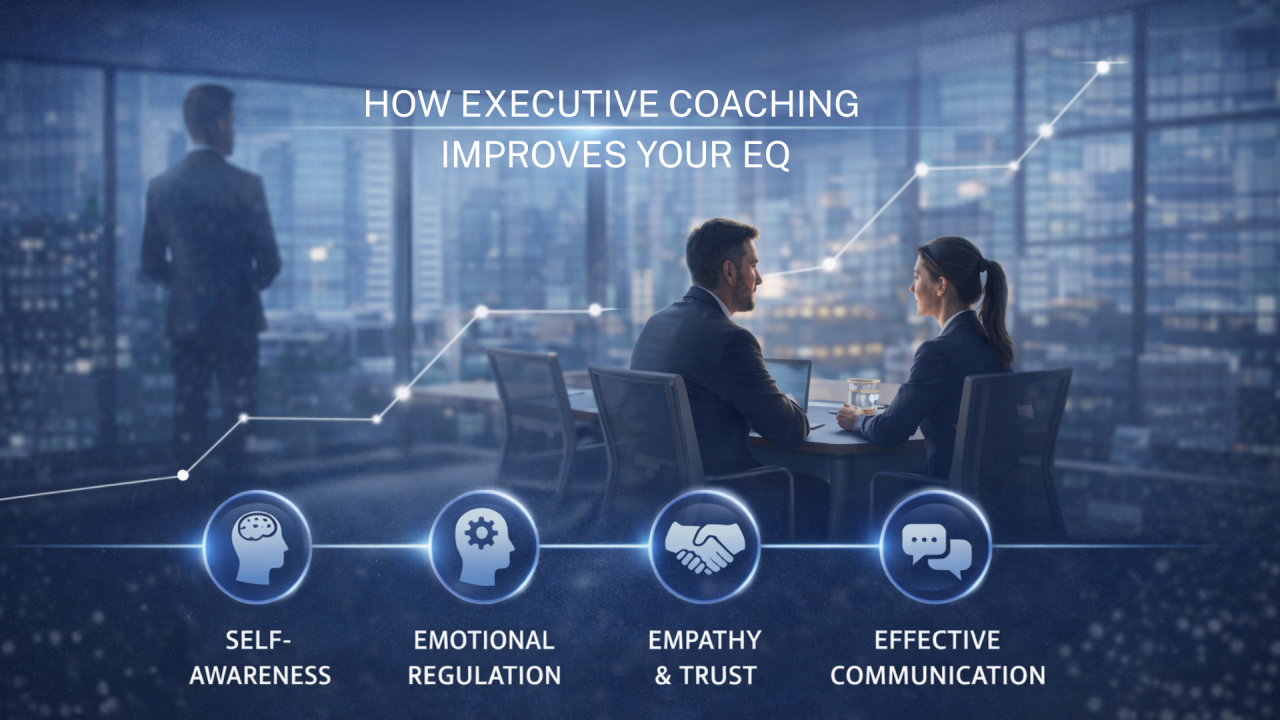
1. Coaching Builds Self-Awareness
EQ begins with understanding how one’s behavior, tone, and decisions impact others. Coaches help leaders identify blind spots, stress responses, and habitual patterns that undermine effectiveness.
2. Coaching Strengthens Emotional Regulation
Under pressure, even strong leaders revert to instinct. Coaching equips leaders with tools to pause, recalibrate, and respond intentionally—especially during conflict, change, or high-stakes decisions.
3. Coaching Improves Communication and Influence
Leaders learn how to listen actively, ask better questions, and deliver feedback without triggering defensiveness. This elevates trust, alignment, and execution across teams.
4. Coaching Creates Accountability for Behavior Change
Unlike training programs, coaching does not end with awareness. Coaches help leaders apply EQ principles in real conversations, meetings, and decisions—then refine their approach over time.
5. Coaching Scales EQ Across the Organization
When leaders model emotional intelligence, it becomes embedded in culture. Teams mirror what leadership demonstrates, creating consistency rather than isolated pockets of good behavior.
The Organizational Impact of Higher EQ
Organizations that leverage EQ through coaching consistently report:
- Stronger leadership presence and credibility
- Higher employee engagement and retention
- Faster conflict resolution
- More effective change management
- Improved collaboration and performance
EQ becomes the multiplier that allows strategy, talent, and execution to work together.
Final Thought
Emotional Intelligence is not about being “nice.” It is about being aware, intentional, and effective—especially when pressure is high and stakes are real.
Executive coaching transforms EQ from an abstract concept into a practical leadership advantage. Organizations that invest in EQ development are not just building better leaders—they are building stronger, more adaptable, and more resilient businesses.