


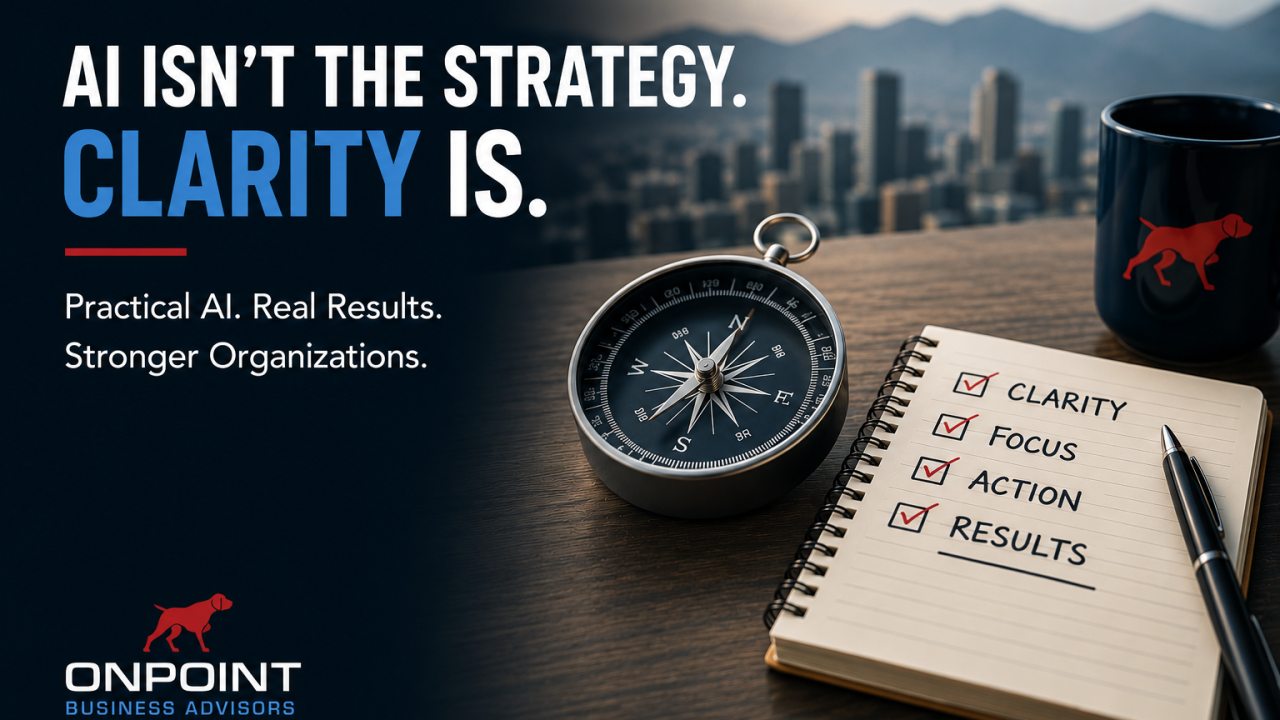
Every conversation I have with business leaders about artificial intelligence begins with some version of the same admission.
“We know we need to be doing something with AI…we’re just not sure where to start.”
It’s a completely reasonable place to be. The pace of change has been extraordinary. Every week brings another platform, another use case, another productivity promise, and another expert insisting that organizations must fundamentally transform how they operate or risk being left behind. For many executives, founders, and business owners, the result isn’t excitement. It’s overwhelm. The pressure to act collides with genuine uncertainty about where to invest time, money, and attention, and that collision tends to produce one of two outcomes.
Some organizations jump headfirst into AI initiatives without a clear objective. They purchase tools, spin up experiments, and generate a lot of internal activity that never quite becomes integrated into the actual business. Others go the opposite direction and become paralyzed, waiting for the perfect strategy, the perfect technology, the perfect moment before taking any action at all. Neither path leads somewhere meaningful.
The most successful organizations I’ve seen start much smaller.
One of the biggest misconceptions surrounding AI is that adoption requires a massive, sweeping transformation. In practice, the organizations seeing the greatest benefit are taking a far more practical approach. They’re not trying to automate everything. They’re not attempting to replace entire departments or rebuild every process from scratch. Instead, they’re asking a much simpler question: What is one problem we can solve today?
That might mean reducing the time it takes to research prospects. It might mean creating better customer communications, or documenting internal processes that currently exist only inside a few employees’ heads. It might mean helping a marketing team produce content more efficiently, or improving how the business handles meeting notes, proposals, or competitive analysis. The specific answer matters less than the discipline behind the question. The point is never the technology itself, it’s identifying a real business challenge and determining whether AI can help address it more effectively.
AI is a leadership challenge, not a technology challenge.
Most conversations about AI frame it as an IT initiative or a software investment. I’d argue it’s increasingly a leadership initiative. The technology is genuinely accessible, and most organizations can acquire capable tools quickly and relatively cheaply. What’s far harder is creating alignment around how those tools should actually be used.
Leaders have to establish priorities. They have to determine where AI can create the most meaningful value and build guardrails to ensure quality, accuracy, and consistency. Most importantly, they have to help their teams understand something that gets lost in a lot of the noise: AI is a tool designed to enhance human judgment, not replace it. Organizations that treat AI purely as a technology investment often struggle to generate lasting results. Those that treat it as a business and leadership initiative tend to make faster, more sustainable progress, because they’ve decided what they’re trying to accomplish before they’ve decided how to accomplish it.
Start with practical wins. Build from there.
When I’m working with organizations early in their AI journey, I consistently encourage the same starting point: focus on practical wins before pursuing more ambitious initiatives. Look for activities that consume significant time but create limited strategic value. Look for repetitive tasks and manual processes. Look for areas where information gathering, analysis, or documentation could simply move faster.
When those early wins land, something important happens. Teams gain confidence. Processes improve. Opportunities that were invisible before become obvious, and the organization develops a much clearer picture of where larger AI investments might eventually make sense, because they’ve built the instincts to recognize the right problems to solve.
The goal isn’t to become an AI company.
Perhaps the most important mindset shift leaders can make right now is this one: the goal is not to become an AI company. The goal is to become a more effective company. A more productive company. A more adaptable one. A company that serves customers better, makes better decisions, and frees its most talented people to focus on the work that actually requires them.
AI can help achieve those outcomes, but only when it’s connected to something specific: a clear objective, a real problem, a defined measure of success. Technology alone is rarely the competitive advantage. The advantage comes from how effectively leaders help their organizations apply it.
The organizations that benefit most from AI over the next several years may not be the ones with the largest budgets or the most sophisticated tools. They may simply be the ones whose leaders create the most clarity, because clarity is what turns technology into results.